
Flatness and Levelness

Definition of Floor Flatness and Levelness​

In the evaluation of concrete floor performance, it is essential to clearly distinguish between flatness and levelness, as these parameters describe different geometric characteristics of the slab surface. This distinction is fundamental within internationally recognized standards such as TR34, ACI, and ASTM

A surface can be level yet not flat, or conversely flat but level. These two characteristics are therefore independent geometric properties.

Both flatness and levelness must be specified, measured, and verified independently. Proper floor assessment therefore requires objective measurement methods and compliance with applicable standards.

1.    Flatness

Flatness refers to the local surface smoothness of a floor. It characterizes the presence or absence of short-wavelength irregularities such as bumps, ridges, or undulations.

From an engineering perspective, flatness directly influences:

  • Operational efficiency and safety of wheeled equipment (e.g., forklifts and VNA trucks)
  • Dynamic loading effects on industrial vehicles
  • Surface finish appearance and light reflectivity
  • Performance and durability of applied floor coverings

Poor flatness increases vibration, accelerates equipment wear, and may reduce vehicle handling precision.

2.    Levelness

Levelness describes the degree to which a floor surface conforms to a true horizontal plane. It reflects long-wavelength elevation differences across larger areas.

Levelness is particularly critical for:

  • High-bay racking and storage systems
  • Installation tolerances of partitions and movable walls
  • Automated storage and retrieval systems (AS/RS)
  • Air-bearing or precision-guided vehicles

Insufficient levelness may lead to rack misalignment, load eccentricity, or structural instability.

Importance of Floor Flatness in High-Bay Warehouses

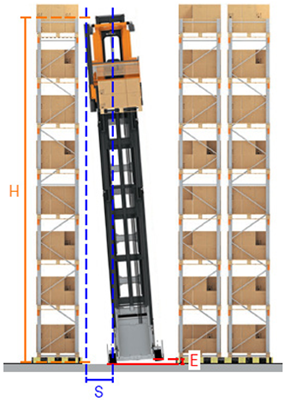
In high-bay and Very Narrow Aisle (VNA) warehouses, floor flatness is a governing engineering parameter for operational safety and system performance. At high rack heights, small floor elevation differences generate amplified deviations at lifting height due to geometric magnification.

1.    Geometric Amplification Mechanism:

For a reach truck:

  • Let E = elevation difference between right and left wheels
  • Let W = wheel track width
  • Let H = lift height
  • Deviation at height: S = H × (E / W)

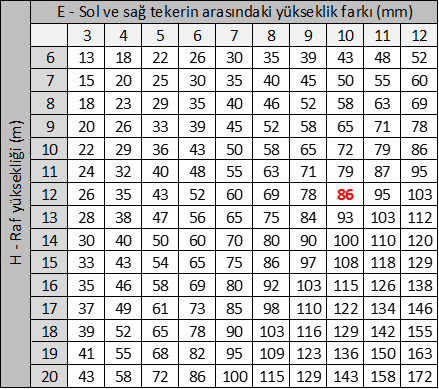
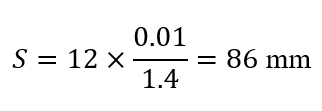
2.    Example (technical calculation):

  • W = 1.4 m
  • E = 10 mm
  • H = 12 m

Thus, a 10 mm transverse level difference produces 86 mm lateral deviation at 12 m height. 

3.    Static vs. Dynamic Condition

The calculated deviation (S) alone is not the principal operational concern.

If inclination remains constant along the travel path, the truck operates on a uniform slope. While this influences balance and hydraulic performance, it does not inherently generate instability.

The critical factor is variation of slope magnitude and direction over short travel increments. These rapid changes induce:

  • Oscillation of the mast
  • Dynamic amplification of sway
  • Resonance-like behaviour during travel

This dynamic response increases as:

  • Rack height increases
  • Travel speed increases
  • Surface irregularity frequency increases

4.    Operational and Structural Consequences

Dynamic oscillation leads to measurable performance and safety impacts:

a)     Mechanical Effects

  • Increased mast deflection during high lifting
  • Progressive wear of guide rollers and bearings
  • Fork desynchronization at identical rack coordinates
  • Elevated stress in chassis and steering assemblies

b)    Safety Risks

  • Higher probability of rack upright impact
  • Increased risk of pallet displacement
  • Load instability at upper elevations
  • Activation of truck safety interlocks and emergency stop systems

c)     Productivity Impact

  • Reduced travel speed (typically 40–60% loss in severe conditions)
  • Increased cycle times
  • Operator fatigue and stress
  • Frequent system resets after safety-trigger activation

d)    Economic Impact

  • Premature equipment failure
  • Increased maintenance downtime
  • Rack repair costs
  • Operational interruption losses

5.     Engineering Quantification – Floor Flatness

The frequency, magnitude, and spatial distribution of slope variations are quantified through standardized flatness parameters.

In VNA and high-bay environments, floor performance must be assessed under Defined Movement (DM) or Fmin classification systems depending on the applicable international standard. These systems evaluate:

  • Transverse elevation difference
  • Transverse rate of change
  • Longitudinal elevation difference
  • Longitudinal rate of change

6.    Compliance Assessment

The assessment verifies whether the floor satisfies minimum flatness criteria required for safe forklift operation at specified rack heights.

If non-compliant, corrective engineering solutions are developed based strictly on measured survey data and calculated deviation parameters.

Importance of Flatness versus Levelness

For the majority of applications, floor flatness is more critical than levelness. Insufficient flatness produces permanent operational consequences: dynamic vehicle movement, increased mechanical wear, operator fatigue and injury risk, visible surface waviness, and incompatibility with surface finishes. Material handling efficiency decreases, requiring additional equipment, increased manpower, and higher maintenance expenditure.

In contrast, inadequate levelness generally results in localized installation adjustments for racking or storage systems. It rarely affects long-term serviceability or forklift performance. Therefore, flatness directly governs operational efficiency and lifecycle cost, while levelness primarily influences installation tolerance.

Explore more

Laser Grinding

Our advanced measurement technologies and engineering methods

International Flatness Standards

Detaily understand the flatness standards like ASTM, TR34 and VDMA

Importance of Floor Flatness

Why floor flatness can affect the operation's speed, safety, and cost..

Get In Touch
Find Us
Follow Us

Send us a message

Bu formu bitirebilmek için tarayıcınızda JavaScript'i etkinleştirin.