TR34 4th Edition (FM)

In Free Movement (FM) areas, full-surface measurement is impractical; therefore, TR34 requires a statistically representative survey sample. According to TR34 (4th Edition, Table 3.1), two primary surface regularity properties shall be assessed, Property E for Levelness and property F for Flatness.
1. Classification

TR34-Table 3.1:

Floor Class
Typical
Property E
Property F

FM1

Where very high standards of flatness and levelness are required.
Reach trucks operating at above 13m without side-shift.

4.5

1.8

FM2

Reach trucks operating at above 8 – 13m without side-shift.

6.5

2.0

FM3

Retail floors to take directly applied flooring. Reach trucks operating at up to 8m without side-shift.
Reach trucks operating at up to 13m with side-shift.

8.0

2.2

FM4

Retail floors to take applied screeds.
Workshops and manufacturing facilities where MHE lift heights are restricted to 4m.

10

2.4

2. Survey Procedure

a)     Levelness (Property E)

The survey is made on a 3.0 m × 3.0 m survey grid using an automatic laser measurement system.

Measured elevation data are exported in DWG format or tabulated form for evaluation. From these recorded elevations, the differences between adjacent 3.0 m grid points are calculated.

The resulting elevation differences are then statistically analysed to determine compliance with the applicable Property E tolerance criteria.

b)    Flatness (Property F)

the Dip-Stick is manually traversed along the floor surface, collecting measurement data digitally at defined intervals.

At the completion of each survey run, the recorded data are downloaded automatically to a smartphone, after which the next run can commence without delay. Once the required cumulative survey length has been achieved, the complete dataset is transferred from the smartphone to a laptop or PC for processing.

The dataset is automatically analysed. The software calculates the  percentile value from all survey runs and generates the corresponding Property F graphical outputs for compliance evaluation.

3. Calculations

a)     Levelness (Property E)

Property E evaluates levelness as the elevation difference between two opposing points spaced 3.0 m apart, arranged on a 3.0 m × 3.0 m grid.

  • The survey grid is accurately established at 3 m intervals.
  • Zones within 1.5 m of walls, columns, or fixed structures are excluded.
  • Elevation readings are taken at each grid intersection.
  • Measured values are processed to determine Property E results.
  • No surveyed point shall exceed ±15 mm relative to a fixed datum plane.


b)     Flatness (Property F)

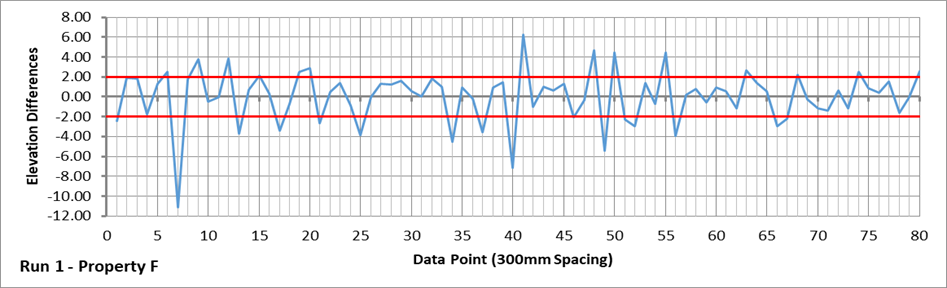
Property F quantifies flatness as the change in elevational difference between two consecutive measurements, each taken over a 300 mm interval.

To ensure that sampling density is proportional to floor size and statistically representative. The minimum required survey run length is determined by: L=A/10

Where:

  • L = minimum total survey run length (m)
  • A = total surveyed floor area (m²)

Property F – Data Processing and Graphical Interpretation:

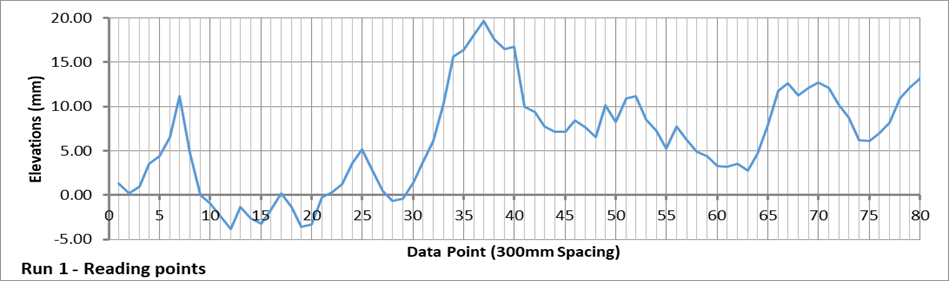
For each measurement run, elevation readings are plotted to represent the actual transverse floor profile along the surveyed line. These graphical outputs illustrate the measured cross-section and local surface variation.

All Property F measurements from the survey runs are compiled and statistically analysed.

For each run, a Property F trace graph is generated. Where the trace intersects or exceeds the defined tolerance limits, this indicates that the 95% criterion is locally exceeded at that position. Tolerance boundaries are identified as limit lines (marked in red) on the graph.

After analysing the full sample of Property F runs, the overall 95% percentile value for the entire dataset is calculated and reported in the results table. This value represents the governing flatness compliance indicator for the surveyed area.

Explore more

Laser Grinding

Our advanced measurement technologies and engineering methods

ASTM Standard

ASTM E1155 defines FF/FL values to evaluate general warehouse floors for FM

Importance of Floor Flatness

Why floor flatness can affect the operation's speed, safety, and cost..

Get In Touch
Find Us
Follow Us

Send us a message

Bu formu bitirebilmek için tarayıcınızda JavaScript'i etkinleştirin.