ACI (Fmin)

For floors subjected to defined traffic patterns (e.g., VNA aisles), surface control differs from free-movement floors. The ASTM FF and FL or TR34 Properties F and E are not applicable, as they rely on random sampling across the slab. There is no direct correlation between Free Movement (FM) and Defined Movement (DM) systems; they are fundamentally different measurement methodologies with no equivalent conversion index.
1. Classification

Defined-movement floors are controlled by a single parameter: Fmin.

Fmin represents the minimum acceptable flatness and levelness condition within a VNA aisle. The required Fmin value is determined according to:

  • Reach truck dimentions
  • Rack height


Reference values are provided in ACI 360R-10, “Guide to Design of Slabs-on-Ground,” Table 1.1, which assigns Fmin classifications based on rack elevation.

Classification
F-Min Number

Conventional

25

Moderateley Flat

38

Flat

50

Very Flat

75

Super Flat

100

Rack Height (m)
Longitudinal F-Min
Transverse F-Min

0-8

50

60

8-9

55

65

9-11

60

70

11-12

65

75

12-14

70

80

14-15

75

85

15-20

90

100

20-27

100

125

2. Survey Procedure

a)     Levelness (Property E)

For Very Narrow Aisle (VNA) floors, wheel traces are clearly defined along each aisle. Measurement runs are performed according to the reach truck wheel configuration:

  • 3-wheel trucks: Three runs are measured (right, middle, left wheels).
  • 4-wheel trucks: Two runs are measured (right and left wheels).


All runs must be perfectly parallel, starting and ending at the exact same reference lines, to ensure accurate collection of transversal elevation values.

After each aisle survey, data are automatically downloaded to the smartphone connected to the Dipstick, allowing continuous measurement of subsequent aisles. Upon completion of all aisles, the full dataset is transferred to a laptop or PC for calculation, analysis, and reporting of flatness and levelness results.

3. Calculations

a)     Terms

Transverse Tolerances (Tilt and ΔTilt)

  • Tilt: Defines the maximum elevation difference between the front load wheels (right and left).
  • ΔTilt: Represents the transverse rate of change in elevation for every 300mm of travel.

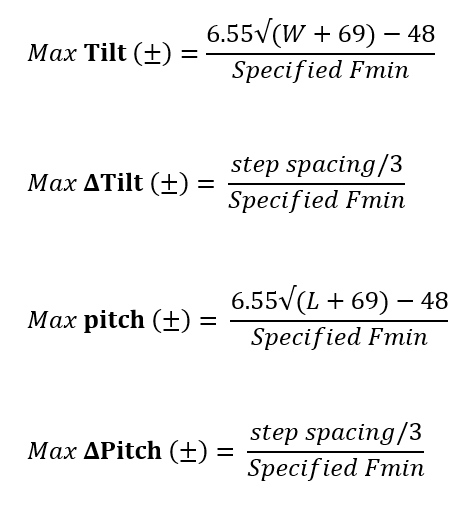
These properties measure elevation differences across the aisle width, specifically between the two front (right and left) wheels of the MHE. The specified transversal limits for each classification change according to the distance between the front wheels (W)

Longitudinal Tolerances (Pitch and Δpitch)

  • pitch: Indicates the elevational difference between the front and rear axles.
  • Δpitch: Defines the longitudinal rate of change in elevational difference per 300mm of travel.

These properties measure elevation differences along the length of the aisle between the front and rear axles of the MHE. The specified transversal limits for each classification change according to the distance between the front and back wheels (L)


b)     Limit Calculations

c)     Analysing

After determining the Actual Maximum Pitch and Maximum ΔPitch from the classification table:

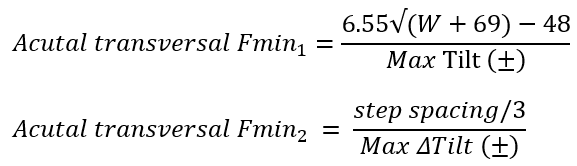
  • The Actual Transverse Fmin is calculated using two ACI-specified formulas.
  • The smaller of the two calculated results governs.

Similarly:

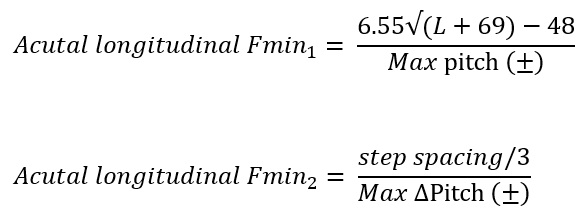
  • The Actual Longitudinal Fmin is calculated using two ACI-specified formulas.
  • The smaller result governs.

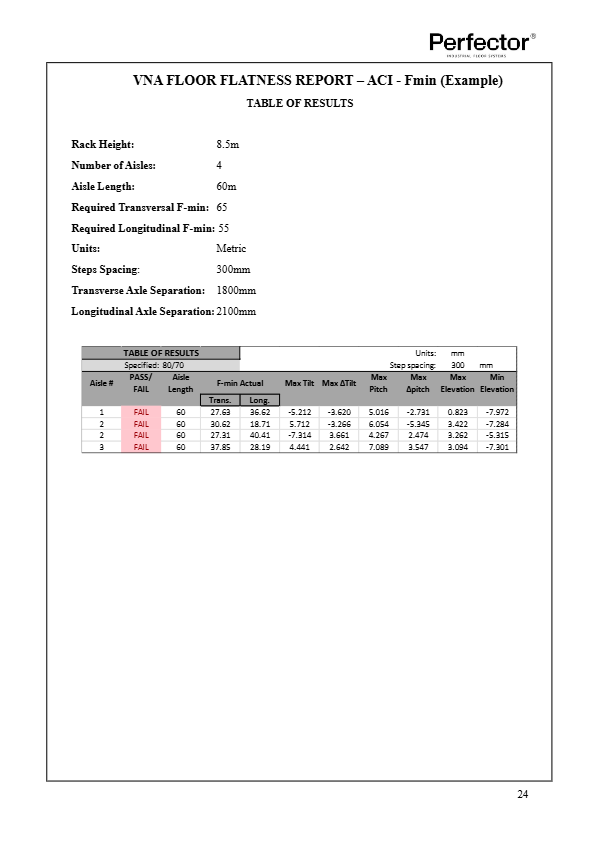
The final report presents separate transverse and longitudinal Fmin values for each aisle, verifying compliance with the required classification.

Explore more

TR34 4th Edition (FM)​

sets strict tolerances along wheel tracks for guided warehouse operations for Defined Movement / VNA Warehouses

ASTM (F-Numbers)

defines FF/FL values to evaluate general warehouse floors where vehicles move freely in all directions

Importance of Floor Flatness

Why floor flatness can affect the operation's speed, safety, and cost..

Explore more

TR34 4th Edition (FM)

sets strict tolerances along wheel tracks for guided warehouse operations for Defined Movement / VNA Warehouses

ASTM (F-Numbers)

defines FF/FL values to evaluate general warehouse floors where vehicles move freely in all directions

Importance of floor flatness

Why floor flatness can affect the operation's speed, safety, and cost..